Rashmi
 Share this
You probably already know what insecurity feels like—the overthinking, self-doubt, comparison, or quiet fear that maybe you’re not “good enough.” If you’ve ever caught yourself wondering, “How do I become less insecure?”, you’re far from alone. The truth is, insecurity isn’t a permanent personality trait. It’s often a habit of thinking that can be challenged, softened, and gradually unlearned. In this guide, you’ll learn how to battle insecurity, understand where it comes from, and discover practical ways to overcome your insecurities without becoming someone you’re not.
Key Takeaways
- Insecurity is a feeling of self-doubt or uncertainty that affects how people view themselves and interact with others.
- Self-awareness helps identify the root causes of insecurity and makes personal growth more effective.
- Negative self-talk strengthens insecurity, while positive reframing builds confidence over time.
- Small daily actions improve self-confidence more effectively than waiting to feel “ready.”
- Healthy boundaries and supportive environments reduce emotional triggers that fuel insecurity.
- Confidence grows through repeated action, while insecurity often grows through avoidance.
- Long-term self-esteem develops through consistent habits, self-compassion, and patience.
What Does It Mean to Overcome Your Insecurities?
Overcoming insecurities means learning how to manage self-doubt so it no longer controls your choices, confidence, or relationships.
Everyone feels insecure sometimes. Even people who seem confident on the outside experience moments of doubt. The difference is that confident people don’t let insecurity make every decision for them.
For example, insecurity may sound like:
- “I’m not smart enough.”
- “What if people judge me?”
- “I’ll never be as good as them.”
- “Why would anyone choose me?”
The problem isn’t having these thoughts occasionally. The problem begins when insecurity becomes the voice you trust the most.
Insecurity is a feeling of uncertainty, self-doubt, or lack of confidence that affects how people view themselves and interact with others.
Sometimes insecurity shows up emotionally. Other times, it appears in very specific areas of life.
Here are some common types of insecurity:
| Type of Insecurity | Example |
|---|---|
| Appearance insecurity | Feeling unhappy about your body or looks |
| Relationship insecurity | Constant fear of rejection or abandonment |
| Career insecurity | Feeling “not good enough” at work |
| Social insecurity | Fear of judgment in social situations |
| Self-worth insecurity | Feeling inadequate or undeserving |
The good news? Insecurity is learned—and what is learned can also be unlearned.
Why Do People Feel Insecure About Themselves?
People feel insecure because experiences, environments, and thought patterns shape how they see themselves over time.
Insecurity rarely appears overnight. Usually, it develops slowly through repeated experiences, comparison, criticism, or disappointment.
According to research, social comparison can strongly influence self-esteem and emotional well-being — Source: American Psychological Association, 2024.
Let’s explore some of the biggest causes.
The Modern Comparison Trap
Comparison strengthens insecurity because people compare their behind-the-scenes struggles to someone else’s highlights.
Social media has made comparison easier than ever. You scroll through polished vacations, perfect relationships, career wins, and glowing selfies while sitting with your own fears and bad days.
But here’s what’s important to remember:
You’re comparing your full reality to someone else’s edited moments.
For example, someone posting happy relationship photos may still struggle privately. A person celebrating career success may still battle anxiety or burnout.
This doesn’t mean social media is bad. It simply means you have to protect your perspective.
Ask yourself:
Does following this person inspire me—or quietly make me feel worse about myself?
Sometimes the healthiest thing you can do is unfollow accounts that constantly trigger comparison.
In many cases, insecurity grows stronger because of persistent negative self-talk that quietly affects your confidence every day.
Past Conditioning and Old Stories
Past experiences often shape insecurity by teaching people limiting beliefs about themselves.
Sometimes insecurity begins in childhood. Maybe someone criticized you constantly. Maybe you grew up feeling overlooked, compared, or rejected.
Even one painful experience can quietly create a story in your mind:
- “I’m not attractive enough.”
- “People always leave.”
- “I’m not talented.”
- “I’m not lovable.”
The difficult part is this: after a while, those thoughts start sounding like facts.
But they are not facts.
They are stories formed from experiences.
And stories can be rewritten.
For example, failing once doesn’t mean you’re incapable. A breakup doesn’t mean you’re unworthy of love. Being shy doesn’t mean you’ll never feel confident.
Self-awareness is the first step toward changing the beliefs that insecurity built.
Why Is It Important to Overcome Insecurities?
Overcoming insecurities matters because chronic self-doubt can quietly affect your relationships, opportunities, happiness, and self-esteem.
When insecurity grows unchecked, it begins making decisions for you.
It might stop you from:
- Speaking up
- Trying something new
- Setting boundaries
- Applying for opportunities
- Building healthy relationships
- Feeling genuinely happy
Insecurity often keeps people stuck—not because they lack ability, but because they stop trusting themselves.
According to mental health research, low self-esteem is linked to higher stress, anxiety, and reduced life satisfaction — Source: Mental Health Foundation, 2024.
At the same time, building confidence doesn’t mean becoming arrogant.
It means becoming secure enough to say:
“I may not be perfect, but I’m still worthy.”
That small mindset shift changes everything.
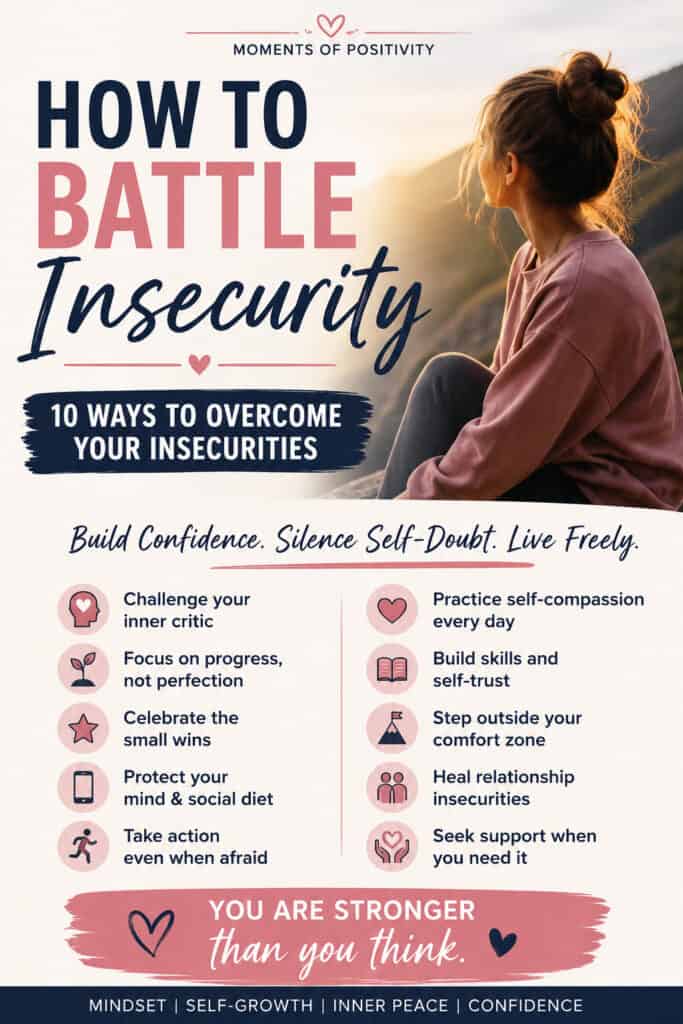
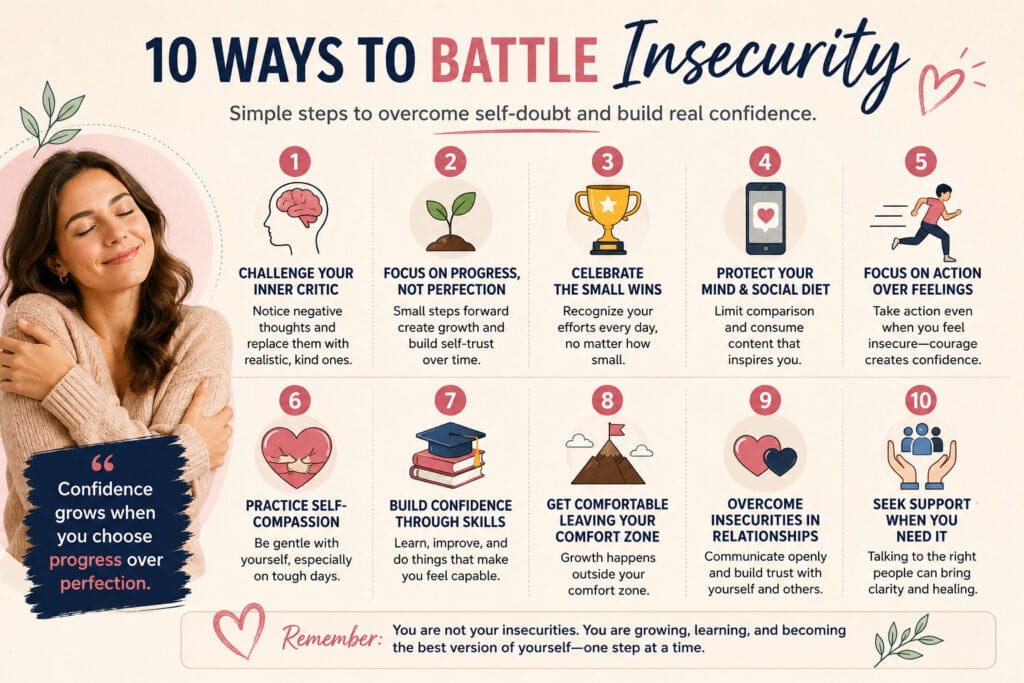
How to Battle Insecurity: 10 Practical Ways to Overcome Your Insecurities
Overcoming insecurities involves identifying negative beliefs, challenging self-doubt, and building confidence through consistent action.
You don’t need to become a totally different person.
You simply need healthier ways to respond to the insecure thoughts that already exist.
Let’s start with the first steps.
1.Audit and Challenge Your Inner Critic
Negative self-talk strengthens insecurity because repeated criticism slowly becomes self-belief.
Most insecure thoughts sound automatic.
You may not even notice them anymore.
Things like:
- “I always mess things up.”
- “I’m awkward.”
- “No one really likes me.”
- “I’ll probably fail.”
But here’s the truth:
Not every thought deserves to be believed.
Start paying attention to your inner voice.
When a negative thought appears, ask:
- Is this actually true?
- What evidence supports it?
- Would I say this to someone I love?
For example:
Instead of:
“I’m terrible at everything.”
Try:
“I’m still learning, and I’ve improved before.”
That small shift matters.
Positive reframing helps weaken insecurity by replacing harsh assumptions with realistic thinking.
Here are some tips to Stop Overthinking.
2.Pivot From Perfectionism to Progress

Perfectionism fuels insecurity because impossible standards make people feel like they are constantly failing.
Many people think confidence comes from getting everything right.
Actually, confidence grows from continuing even when things go wrong. If you wait until you’re perfect to feel worthy, you’ll spend most of life feeling inadequate.
Instead of asking:
“Am I good enough?”
Ask:
“Am I growing?”
There’s a huge difference.
For example:
Instead of aiming to become perfectly confident overnight, focus on smaller goals:
- Speaking up once in a meeting
- Posting something without overthinking it
- Saying no without guilt
- Trying something outside your comfort zone
Progress builds evidence.
And evidence builds confidence.
Confidence grows through repeated action, while insecurity becomes stronger through avoidance.
3.Celebrate the Small Wins
Small wins build confidence because they train your brain to notice progress instead of flaws.
This step sounds simple, but it’s powerful.
Most insecure people constantly focus on what they’re lacking.
They ignore what they’re already doing well.
If you want to become less insecure, start paying attention to tiny victories.
For example:
Today’s small wins might look like:
- Getting out of bed when motivation felt low
- Speaking kindly to yourself
- Going for a walk
- Saying what you truly felt
- Completing one difficult task
You don’t need huge success to feel better.
You need proof that you can trust yourself.
A simple confidence journal can help.
Every evening, write:
3 things I did well today
Over time, this changes your mindset.
Instead of noticing failure all day, you begin noticing growth.
And growth feels hopeful.
Celebrating the small wins helps retrain the brain to focus on capability instead of inadequacy.
4. Protect Your Media and Social Diet
Your environment influences insecurity because what you constantly consume shapes how you think and feel about yourself.
If you constantly surround yourself with negativity, unrealistic standards, or critical people, insecurity naturally becomes louder.
This includes:
- Social media accounts that make you feel inadequate
- Toxic friendships that constantly criticize you
- Content that reinforces fear, perfectionism, or comparison
The goal isn’t to avoid reality. The goal is to protect your peace.
Take a moment to ask yourself:
“Who or what leaves me feeling emotionally drained?”
For example, if certain accounts make you feel “behind in life,” unfollowing them doesn’t make you weak—it makes you self-aware.
At the same time, try replacing negative influences with encouraging and growth-focused content.
You could follow:
- Mental wellness creators
- Confidence-building communities
- Skill-based creators who inspire growth
- Positive personal development accounts
Healthy boundaries reduce insecurity by protecting emotional energy from constant negativity.
5.Focus on Action Over Feelings
Confidence grows through action, not before action.
One of the biggest myths about confidence is this:
“I’ll do it when I feel confident.”
But confidence rarely works that way.
Most confident people didn’t start confident. They became confident by taking action while still feeling nervous.
For example:
- You become better at conversations by talking to people.
- You become more confident at work by practicing your skills.
- You become less insecure socially by showing up, even when it feels uncomfortable.
Action creates evidence.
And evidence slowly tells your brain:
“Maybe I can do hard things after all.”
Try this simple rule:
Feel insecure, but do it anyway.
Even small action matters.
You don’t have to take giant leaps.
Small steps count.
This is especially true when you’re trying to how to battle insecurity in everyday life.
6.Practice Self-Compassion Instead of Self-Criticism
Self-compassion reduces insecurity by helping people respond to mistakes with understanding instead of harsh judgment.
Many insecure people speak to themselves more harshly than they would ever speak to a friend.
Imagine your best friend saying:
“I failed at something today.”
Would you say:
“You’re hopeless.”
Probably not.
You’d likely say:
“You’re learning. One bad day doesn’t define you.”
So why not offer yourself the same kindness?
Research shows self-compassion is linked to lower anxiety and stronger emotional resilience — Source: Harvard Health Publishing, 2024.
Here’s a small mindset shift:
Instead of:
“I messed up. I’m terrible.”
Try:
“I messed up, but I’m still growing.”
That sentence sounds simple.
But repeated kindness changes self-perception over time.
7.Build Confidence Through Skills
Competence reduces insecurity because confidence often grows when people trust their abilities.
Sometimes insecurity shrinks when you become better at something.
For example:
- Public speaking becomes easier with practice
- Career confidence grows through learning
- Social confidence improves through experience
- Fitness confidence improves through consistency
You don’t need to master everything.
Choose one area where insecurity feels strongest and slowly improve it.
Ask yourself:
“What skill would make me trust myself more?”
Then commit to tiny progress.
Maybe:
- Reading 10 pages daily
- Taking a short course
- Practicing communication
- Going for daily walks
Small efforts compound.
8. Get Comfortable Leaving Your Comfort Zone
Growth happens outside comfort zones because new experiences teach the brain that discomfort is survivable.
Insecurity often wants you to stay safe.
Stay quiet. Stay invisible. Avoid embarrassment.
But staying small rarely builds confidence.
Trying new things—even imperfectly—helps you expand what feels possible.
For example:
- Speaking in a meeting
- Going somewhere alone
- Starting a new hobby
- Saying yes to something unfamiliar
At first, it feels uncomfortable.
That’s normal.
Confidence often feels awkward before it feels natural.
9. Overcome Insecurities in Relationships
Relationship insecurity often comes from fear of rejection, abandonment, or not feeling “good enough.”
If you constantly worry:
- “What if they leave?”
- “Do they still love me?”
- “Am I enough?”
You’re not alone.
Relationship insecurity can show up as:
- Overthinking texts
- Jealousy
- Needing constant reassurance
- Fear of abandonment
- Overanalyzing small behaviors
The challenge is this:
Unchecked insecurity can unintentionally damage healthy relationships.
Instead of silently overthinking, try honest communication.
For example:
Instead of:
“You don’t care about me anymore.”
Try:
“I’ve been feeling insecure lately, and I want to talk about it.”
Healthy relationships grow through honesty, reassurance, and trust.
At the same time, remember this:
Your partner can support your healing.
But they cannot completely fix your insecurity for you.
That work starts within.
10. Seek Support When You Need It
Support accelerates healing because insecurity often feels smaller when shared.
Sometimes self-help is enough.
Sometimes deeper support helps.
Talking to:
- A trusted friend
- A mentor
- A therapist
- A coach
can provide perspective you might not see alone.
Asking for help is not weakness.
It’s self-respect.
You don’t have to carry every struggle silently. If insecurity begins affecting your daily life, exploring trusted mental health resources may provide additional support.
Conclusion
Overcoming insecurity doesn’t mean never doubting yourself again—it means learning not to let self-doubt control your life.
Some days will feel easier than others. On certain days, confidence may come naturally. On others, insecurity might feel louder. That’s normal. What matters most is remembering that growth happens slowly, often in small moments you barely notice at first.
Maybe it starts with challenging one negative thought.
Maybe it looks like speaking more kindly to yourself.
Or maybe it’s simply taking one small step outside your comfort zone, even when fear is still there.
The truth is, confidence isn’t built overnight. It grows every time you choose progress over perfection and courage over self-doubt.
So be patient with yourself.
Celebrate the small wins. Keep showing up. And trust that with time, the version of you that feels calmer, stronger, and more secure is already being built—one step at a time.
Which of these steps are you going to try first? Let me know in the comments below—I’d genuinely love to hear your thoughts.
Frequently Asked Questions About Insecurity
No, and that shouldn’t be the goal.
Insecurity is a normal human emotion. The goal is learning how to manage it so it doesn’t control your decisions, relationships, or happiness.
Even confident people experience insecurity sometimes.
The difference is that they don’t let it define them.
The fastest way to become less insecure is to shift your focus outward and take small confident actions daily.
Helping others, practicing kindness, learning new skills, and taking action despite fear can interrupt cycles of overthinking.
Small confidence-building actions work surprisingly well over time.
Persistent insecurity often comes from repeated comparison, negative self-talk, past experiences, or low self-esteem.
Understanding your triggers is the first step toward changing them.
Awareness creates choice.
es, low self-esteem and insecurity are strongly connected.
When people struggle to value themselves, self-doubt often becomes stronger.
The good news?
Self-esteem can improve with healthier habits and self-awareness.
Overcoming insecurity takes time because confidence develops gradually through repeated experiences.
There is no perfect timeline.
Some changes happen in weeks.
Deeper confidence may take months or longer.
What matters most is consistency.