 Rashmi
 Share this
Summarize this article with: ChatGPT | Perplexity | Claude | Grok
Self control is the ability to resist immediate impulses, while self discipline is the ability to consistently take actions that support long-term goals. Neither matters more than the other — they work as a team, and both can be trained. Self control protects you from short-term temptations; self discipline helps you achieve long-term success, usually through systems and habits that reduce the need for willpower.
Two Skills People Confuse Every Day
Most people believe self control and self discipline mean the same thing.
But confusing these two skills often makes personal growth much harder. You exercise self control in the evening, feel exhausted, and wonder why you can’t “just be disciplined.” Or you build a strict routine, hit one stressful week, and conclude you have no self control.
In this guide, you’ll learn exactly how they differ, when each matters, and how to strengthen both to become more consistent in every area of life. You’ll get clear definitions, real-life examples, a comparison table, a 7-day starter challenge, and the exact tools and habits that make discipline feel less like a fight.
What Is Self Control?
Self control is the ability to resist immediate impulses so you can act in line with your longer-term goals.
Self control is a short-term skill. It’s the mental muscle you use in the moment — when the craving, the urge, or the reaction is already happening and you need to choose something better.
It shows up in three main ways:
- Resisting impulses — saying no to the second slice of cake, the impulse purchase, or the snooze button.
- Emotional regulation — staying calm when someone provokes you, instead of firing back.
- Delaying gratification — choosing the long-term reward (a degree, a healthier body) over the immediate one (a party, a fast-food meal).
Common examples: saying no to junk food when it’s offered, closing social media before a deadline, and taking a breath instead of losing your temper.
Self control protects you from short-term temptations. It is the emergency brake. But it runs on limited fuel — which is why a strategy that relies on self control alone rarely lasts.
What Is Self Discipline?
Self discipline is the ability to take consistent, deliberate action toward long-term goals — whether you feel like it or not.
Self discipline is not a moment-by-moment battle. It’s a pattern. It’s built from routines, habits, and commitments that run on repeat, so you don’t have to re-decide every morning.
It shows up as:
- Consistency — doing the work on good days, busy days, and low days alike.
- Routines — a fixed morning, a fixed study time, a fixed training slot.
- Habits — automatic behaviors that no longer require negotiation.
- Long-term action — progress measured in months and years, not hours.
Common examples: studying for 30 minutes every day, exercising on a schedule, and automatically moving money into savings each payday.
Self discipline helps you achieve long-term success. It’s the engine — the part that keeps you moving after the initial motivation fades.
For a full step-by-step system, read our guide on how to build self discipline.
Self Control vs Self Discipline: What’s the Difference?
Self control stops you from doing what you’ll regret; self discipline keeps you doing what will pay off.
Here’s the simplest way to remember it: self control is a no — no to the cookie, no to the tab, no to the angry reply. Self discipline is a yes — yes to the workout, yes to the savings transfer, yes to the 30 minutes of study.
| Self Control | Self Discipline |
|---|---|
| Resisting impulses in the moment | Consistently taking purposeful action |
| Focus: the present temptation | Focus: the long-term system |
| Time frame: seconds to minutes | Time frame: weeks, months, years |
| Trigger: an urge or craving | Trigger: a routine, schedule, or commitment |
| Goal: avoid a short-term mistake | Goal: achieve a long-term result |
| Examples: skipping dessert, closing social media, staying calm in an argument | Examples: daily study, scheduled workouts, automatic saving |
| Difficulty: draining — requires effort each time | Difficulty: hard at first, then easier as habits form |
| Long-term impact: prevents losses | Long-term impact: compounds gains |
Strong habits require less self control over time. The moment a behavior becomes automatic, your emergency brake gets a rest. That’s the whole game: use self control to build the discipline that eventually replaces it.
Which Is More Important?
Neither is more important — self control and self discipline work as a team, and each one covers the other’s weakness.
Imagine a diet. Self control is what stops you from ordering dessert tonight. Self discipline is what keeps you meal-prepping on Sunday for the whole week. Skip the first and you fall off the wagon tonight. Skip the second and you were never really on it.
Imagine a project at work. Self control keeps you off YouTube while you write the report. Self discipline is the weekly planning session that means the report gets written at all.
Self control starts things; self discipline sustains them. When you’re starting a new habit, you lean heavily on self control. As the habit forms, self discipline (in the form of routines and systems) gradually takes over.
The practical rule: don’t put them against each other. Use self control to protect today, and self discipline to build tomorrow.
How Self Control Leads to Self Discipline
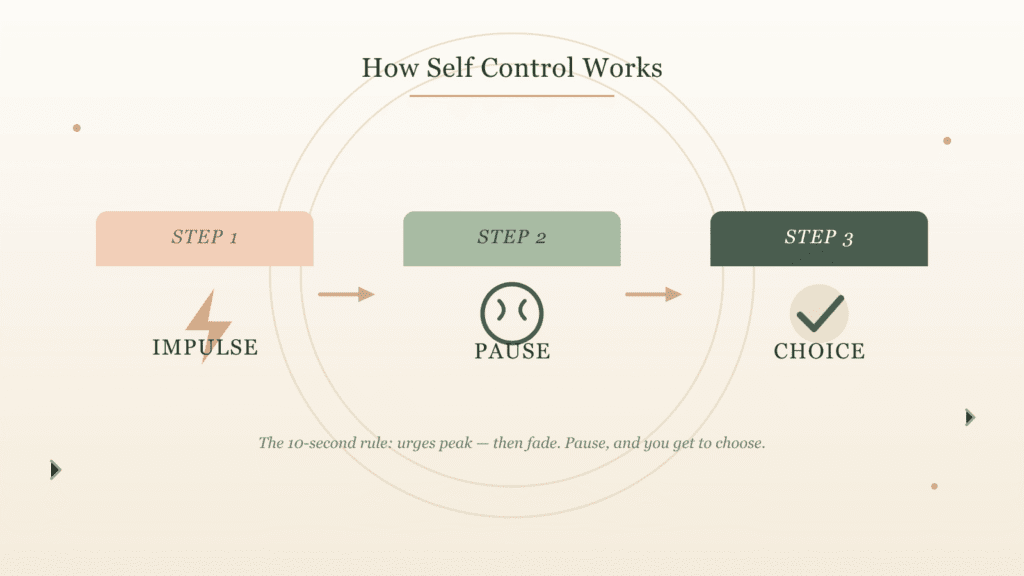
Every moment of self control you practice makes self discipline easier, because it builds the habits that later run on autopilot.
Self control and self discipline aren’t rivals — they’re stages of the same skill.
Habits reduce decision fatigue. Every decision costs mental energy. Studies show that the quality of decisions drops the longer a person decides continuously — researchers found that judges’ favorable rulings declined sharply across a session and rebounded after breaks.
Statistic — Judicial decisions became markedly less favorable as a session wore on, and rebounded after a break — evidence of decision fatigue. Source: Danziger, Levav & Avnaim-Pesso, PNAS, 2011
When you turn a behavior into a habit, you remove the decision entirely. No decision, no fatigue, no need for self control.
Habit loops make this automatic. Every habit runs on a loop: cue → routine → reward. The cue (7 a.m., your gym bag in view) triggers the routine (the workout), which delivers the reward (the endorphin rush). Your brain learns the loop and starts craving the cue — powered partly by dopamine, the neurotransmitter that drives anticipation and motivation.
Discipline needs fewer decisions over time. In week one, every workout is a self control battle. In week twelve, it’s just what you do after coffee. That’s the transition you’re building toward.
As James Clear writes in Atomic Habits: “You do not rise to the level of your goals. You fall to the level of your systems.” Self control is what starts the system. Self discipline is the system itself.
Real-Life Examples
Self control and self discipline show up differently in real life — and you usually need both at different moments of the same day.
Student
- Self control: ignoring the group chat while studying for tomorrow’s exam.
- Self discipline: studying at the same time every evening, weeks before the exam.
Working Professional
- Self control: not checking your phone during a meeting.
- Self discipline: time-blocking your deep-work hours every morning and protecting them.
Fitness Journey
- Self control: choosing water over soda at dinner.
- Self discipline: showing up to the gym three times a week, rain or shine.
Money Management
- Self control: skipping the impulse buy in your cart.
- Self discipline: automating a savings transfer every payday before you can spend it.
Screen Time
- Self control: closing the app after one scroll.
- Self discipline: keeping your phone outside the bedroom at night, every night.
Notice the pattern: self control wins the individual battles; self discipline wins the war. For focused tactics on the screen-time version, see our digital detox strategies.
Common Mistakes People Make
Most people fail at self control and self discipline by making the same seven mistakes — and every one of them is avoidable.
- Relying on motivation. Motivation is a feeling, and feelings fluctuate. Systems don’t.
- Expecting perfection. One missed day becomes “I already ruined it” — and the whole streak collapses. Plan for off days instead.
- Having no routine. Without a fixed time and place, every day is a fresh negotiation you’ll lose.
- Pursuing too many goals at once. Willpower is a shared budget; spreading it across five goals means funding none of them.
- Ignoring burnout. Discipline without recovery is just a longer runway to collapse.
- Running on poor sleep. A sleep-deprived brain is measurably worse at self regulation.
Statistic — About 1 in 3 U.S. adults report not getting enough sleep, and sleep deprivation measurably impairs the brain regions behind self control. Source: CDC, 2020
- Letting digital distractions roam free. Every notification is a temptation you invited into your pocket. The fix is boring and effective: turn them off.
If procrastination is your specific struggle, start with how to overcome procrastination fast.
How to Improve Self Control
You can improve self control in seven practical steps, starting with the simplest one: pause before you act.
Step 1: Pause before acting. Build a 10-second rule. Before reaching for the snack, the tab, or the reply, take one full breath. The urge usually peaks and starts to fade within that window.
Step 2: Practice mindfulness. You can’t manage an impulse you don’t notice. A few minutes of daily mindfulness trains you to observe urges without automatically obeying them.
Step 3: Remove triggers. You are not obligated to fight every battle. If the cookies are a problem, don’t buy the cookies.
Step 4: Sleep more. Sleep restores the prefrontal cortex — the brain region that runs self control. Treat 7–9 hours as a performance requirement, not a luxury.
Step 5: Exercise regularly. Exercise is proven training for self regulation. It builds the same neural circuitry you need to say no.
Step 6: Eat for steady energy. Blood sugar crashes and willpower crashes arrive together. Prioritize protein, fiber, and regular meals.
Step 7: Reduce stress. Chronic stress is the enemy of self control. Walk, breathe, talk to someone — anything that genuinely lowers your load.
Environment often beats willpower. Every trigger you remove is a self control battle you never have to fight.
How to Build Self Discipline
You can build self discipline in six steps that focus on systems, not motivation.
Step 1: Set one clear goal. Define what “done” looks like. Vague goals produce vague effort. See goal setting methods that work.
Step 2: Start with micro habits. Make the new behavior so small it’s embarrassing: one push-up, one page, one minute of study. Small enough to do on your worst day.
Step 3: Time-block it. Give the habit a fixed appointment in your calendar. If it’s not scheduled, it’s negotiable — and you will lose the negotiation. Use effective time management strategies.
Step 4: Track it. A visible streak is powerful feedback. Mark the calendar, check the box, log the workout.
Step 5: Add accountability. Tell someone your commitment, join a group, or find a partner. Disappointing a system is easy; disappointing a person is hard.
Step 6: Review weekly. Spend ten minutes each week asking: what worked, what didn’t, what will I change next week? Adjustment is what keeps discipline alive. For keeping the streak going, see how to stay consistent with habits and our morning routine for discipline.
Statistic — New behaviors take an average of 66 days to become automatic, with a range of 18 to 254 days. Source: Lally et al., European Journal of Social Psychology, 2010
7-Day Self Control and Self Discipline Challenge
The 7-Day Self Control and Self Discipline Challenge gives you one small task per day for one week — enough to feel the difference quickly.
| Day | Task | Expected Benefit |
|---|---|---|
| Day 1 | Remove your #1 trigger from sight (app, snack, tab) | Fewer battles to fight; instant relief |
| Day 2 | Pick one micro habit and do it for 2 minutes | Proof that starting is easier than you think |
| Day 3 | Set the “if-then” plan: “If X, then Y” | Doubles the odds you follow through |
| Day 4 | Time-block one 25-minute focus session | A taste of deep work without overwhelm |
| Day 5 | Sleep 30 minutes earlier than usual | Better self regulation tomorrow |
| Day 6 | Track your streak visibly (calendar, app) | Momentum you can actually see |
| Day 7 | Write a 10-minute weekly review | A plan for week two that fits your life |
Statistic — People who made specific “if-then” implementation plans were significantly more likely to achieve their goals, across a meta-analysis of 94 studies. Source: Gollwitzer & Sheeran, Advances in Experimental Social Psychology, 2006
Frequently Asked Questions
Final Thoughts
Self control protects you from short-term temptations; self discipline helps you achieve long-term success — and you are fully capable of building both.
Start small. Pick one trigger to remove and one micro habit to begin. Use the 7-day challenge above to build momentum, and remember the research: people who make specific plans are far more likely to follow through.
Statistic — People who made New Year’s resolutions were about 10 times more likely to succeed at changing a behavior after six months than people who wanted to change but made no resolution. Source: Norcross et al., Journal of Clinical Psychology, 2002
And if your inner voice needs strengthening along the way, our guide on how to start a daily affirmation practice that actually works pairs perfectly with this one — affirmations rewire the mind, discipline runs the body.
Read our complete guide: Self Discipline: The Complete Guide to Building Daily Discipline